Most women in perimenopause do well aiming for about 1.0 to 1.2 grams of protein per kilogram of body weight a day, and up to about 1.6 if you strength train. For a 150-pound woman, that's roughly 70 to 80 grams a day, or closer to 110 if she lifts. Try to spread it out, with 25 to 30 grams at each meal, starting at breakfast.
In this article
There's no official "perimenopause protein" number, so this is how I'd walk a friend through it: why your needs shift in your 40s, a weight-to-grams table, and how to actually eat that much without a blender or a spreadsheet.
Why protein needs change in perimenopause
As estrogen drops through the menopause transition, women tend to lose muscle mass and strength and gain fat around the middle. A review of the research pointed to low physical activity and low protein intake as two of the main contributors to muscle loss after menopause that you can actually change (Maltais and colleagues, 2009). Muscle is what carries the groceries, gets you up off the floor after playing with your kids, and keeps you steady for decades.
The official Recommended Dietary Allowance for protein is 0.8 grams per kilogram. That number was set to prevent deficiency in healthy adults. It wasn't designed to protect muscle as you age. Expert groups focused on aging recommend more: at least 1.0 to 1.2 grams per kilogram for healthy older adults, and more for people who are active or ill (Bauer and colleagues, 2013; Deutz and colleagues, 2014). Those guidelines were written for people over 65. Muscle loss starts well before then, though, so I think the same range is a sensible place to start in midlife. Your own clinician can fine-tune it.
How much protein do you need in perimenopause? A simple table
Find your weight, then pick a column. The middle column is a sensible everyday target. The right column is for women who strength train several times a week. It's about where extra protein stopped adding more muscle in studies of people lifting weights (Morton and colleagues, 2018).
| Body weight | 1.0 g/kg (minimum) | 1.2 g/kg (everyday target) | 1.6 g/kg (if you lift) |
|---|---|---|---|
| 120 lb (54 kg) | 54g | 65g | 87g |
| 140 lb (64 kg) | 64g | 76g | 102g |
| 160 lb (73 kg) | 73g | 87g | 116g |
| 180 lb (82 kg) | 82g | 98g | 131g |
| 200 lb (91 kg) | 91g | 109g | 145g |
To do the math yourself, divide your weight in pounds by 2.2 to get kilograms, then multiply by 1.2. If you have kidney disease or have been told to limit protein, check with your clinician before eating more.
How much protein per meal?
About 25 to 30 grams. How you spread protein through the day seems to matter too, not just the total. In one small study, adults who ate about 30 grams at each of three meals had higher 24-hour muscle protein synthesis than when they ate the same total piled toward dinner (Mamerow and colleagues, 2014). Plenty of women do the opposite: coffee for breakfast, a light lunch, and most of the day's protein at dinner.
Some rough reference points: a palm-sized portion of chicken, fish or beef is somewhere around 20 to 25 grams. Three eggs are about 18. A cup of plain Greek yogurt is about 20 to 25.
Perimenopause protein breakfast: the meal most women miss
Breakfast is usually where the gap is, and it's also the easiest meal to fix. A few breakfasts that come in near 25 to 30 grams:
- Two eggs and a mug of Bone Broth Protein Mix made with water (about 26g).
- Chocolate Overnight Oats with yogurt, made the night before (about 22g).
- A scoop of Classic Chocolate whisked into 1 cup (8 oz) of dairy milk (about 22g), plus a piece of toast with cottage cheese.
- Chocolate Protein Pancakes on the weekend (about 24g a serving).
I put together a longer list, none of which need a blender, in high-protein breakfast ideas for perimenopause.
“During perimenopause, I think prioritizing protein at breakfast is especially helpful for building a balanced, satisfying meal. Think a simple mug of Rae Basics alongside eggs, Greek yogurt or fruit for an easy way to add protein without overcomplicating breakfast.”
Skotie Rae, RN, founder
Do you have to eat protein first thing in the morning?
No, you don't need to eat the minute you wake up. But getting a real dose of protein into your first meal, instead of running on coffee until noon, is one of the simplest changes you can make, because it evens out your protein across the day. If you're not hungry early, a warm drink with protein in it is often easier than a plate of food, and it still counts.
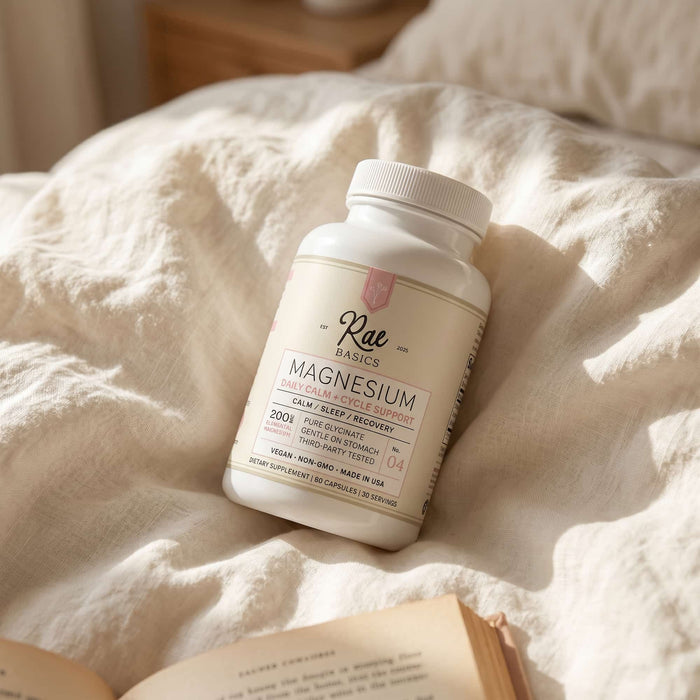
Breakfast handles the protein side. Many women pair it with magnesium at night, since women 31 and older need 320mg a day and plenty fall short from food alone. NO. 04 Magnesium Glycinate is 200mg of elemental magnesium in three capsules before bed, and this morning and night routine shows how the two fit together.
Protein coffee in perimenopause
Some women find caffeine hits them differently in perimenopause, especially when sleep is already patchy. The FDA cites up to 400mg of caffeine a day as an amount not generally linked with negative effects in healthy adults, but your personal limit may be lower. Two ways to keep the coffee ritual:
- Stir a scoop of Mocha into your regular coffee for a protein mocha. Mocha has 0mg of caffeine, so the only caffeine is what's already in your cup.
- Swap one cup of coffee for Caffeinated Chocolate, which has 60mg of natural caffeine per scoop from green coffee beans, roughly two-thirds of a typical cup.
Our guide to putting bone broth protein in coffee covers how to keep it from clumping.
Is 14 grams of protein enough?
One scoop is a good start, not a full meal's worth. One 21g scoop of grass-fed Bone Broth Protein Mix has 14g of protein, 10g+ of naturally occurring collagen and 0g sugar. Whisked into 1 cup (8 oz) of dairy milk it's about 22g, and made with water next to two eggs it's about 26g. That's the difference between a coffee-only morning and one that actually counts toward your target.
Bone broth protein is rich in collagen, which is lower in leucine and has almost no tryptophan. It isn't a complete protein, so it works best alongside other protein foods, not as your only source. I explain why in is bone broth protein a complete protein? All our nutrition numbers are on Rae Basics at a glance.
Quick answers
How much protein should a woman in perimenopause eat a day?
A practical target is 1.0 to 1.2 grams per kilogram of body weight, or up to about 1.6 if you strength train. For a 150-pound woman, that's about 70 to 80 grams a day.
How much protein should I eat at breakfast?
Aim for 25 to 30 grams. Eggs, Greek yogurt, cottage cheese and a protein drink made with milk are the easiest ways to get there.
Is there a perimenopause protein calculator?
Divide your weight in pounds by 2.2, then multiply by 1.2 for an everyday target or 1.6 if you lift. The table above does the math for common weights.
Can I get too much protein?
For healthy women, intakes in these ranges are generally considered safe. If you have kidney disease or have been told to limit protein, ask your clinician first.
Does a protein drink count as breakfast?
It counts toward your protein. For a full breakfast, pair it with something like eggs, yogurt, fruit or toast.
Sources
- Maltais ML, Desroches J, Dionne IJ. Changes in muscle mass and strength after menopause. J Musculoskelet Neuronal Interact. 2009;9(4):186-197.
- Bauer J, Biolo G, Cederholm T, et al. Evidence-based recommendations for optimal dietary protein intake in older people: a position paper from the PROT-AGE Study Group. J Am Med Dir Assoc. 2013;14(8):542-559.
- Deutz NE, Bauer JM, Barazzoni R, et al. Protein intake and exercise for optimal muscle function with aging: recommendations from the ESPEN Expert Group. Clin Nutr. 2014;33(6):929-936.
- Morton RW, Murphy KT, McKellar SR, et al. A systematic review, meta-analysis and meta-regression of the effect of protein supplementation on resistance training-induced gains in muscle mass and strength in healthy adults. Br J Sports Med. 2018;52(6):376-384.
- Mamerow MM, Mettler JA, English KL, et al. Dietary protein distribution positively influences 24-h muscle protein synthesis in healthy adults. J Nutr. 2014;144(6):876-880.
- U.S. Food and Drug Administration. Spilling the Beans: How Much Caffeine Is Too Much?