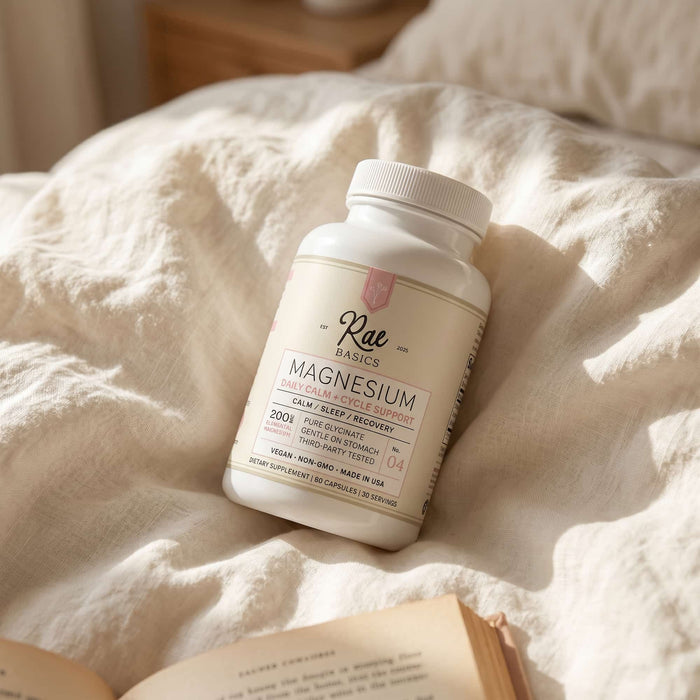
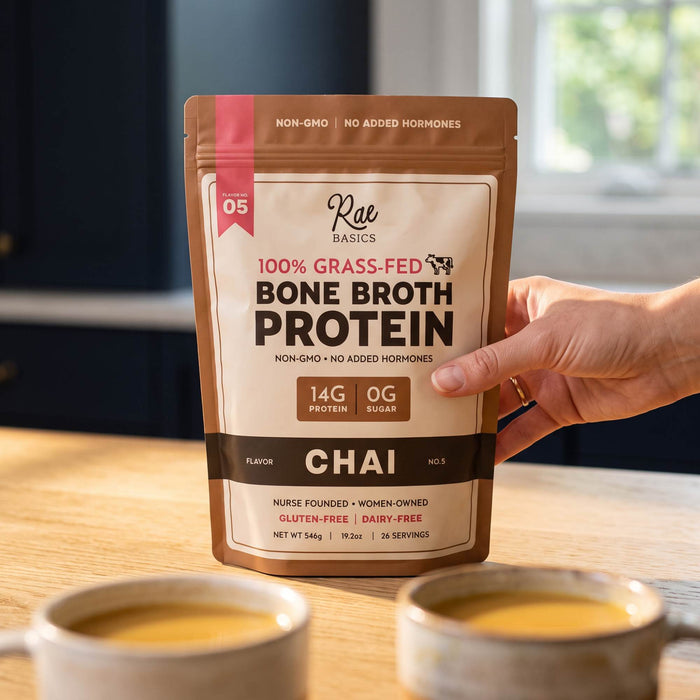
You can add bone broth protein to coffee without clumps if you make a paste first: mix the scoop into a splash of milk so it doesn't clump, then pour in the coffee. One scoop of Rae Basics Bone Broth Protein Mix adds 14g of protein, 10g+ of naturally occurring collagen and 0g sugar, and the cup ends up tasting a lot like a mocha.
In this article
If your coffee is standing in for breakfast, adding protein to it is one of the easiest changes you can make. Below: how to get it smooth, what heat does to protein, how much caffeine you're actually drinking, and when I'd tell you to skip it.
Can you add bone broth powder to coffee?
You can. Most protein mixes are made for cold shakes, but bone broth comes from a food that's already served hot, so a warm mug suits it. Unflavored bone broth in coffee can taste savory, and that's why a lot of people end up choosing a flavored version. Our Bone Broth Protein Mix comes in chocolate, mocha and chai flavors, and a scoop in coffee tastes like a mocha (or a dirty chai), not soup.
Black coffee has almost no protein, about 0.3g a cup. Add one scoop and you're at 14g before you leave the house. Make it with dairy milk the way our Morning Boost recipe does and it's about 17g.
Does bone broth protein clump in hot coffee?
It can if you dump the scoop onto a full mug of very hot coffee. The fix takes ten seconds, and it's the same trick bakers use with cocoa:
- Put the scoop in the empty mug.
- Add 2 to 4 oz of milk (or a little water) and stir it into a smooth paste.
- Pour in the hot coffee slowly while you stir, or run a handheld frother for 10 seconds.
Mixing it into a little liquid first means a spoon is all you need. For iced coffee, flip the order: shake the scoop with cold milk for 15 seconds, then pour it over coffee and ice. Our recipe technique notes cover both.
Does heat destroy collagen or protein?
No, and this is one of the worries I hear most. Heat changes the shape of a protein (it "denatures," or unfolds, it), but the amino acids your body uses are still there. Your stomach acid and digestive enzymes unfold proteins anyway, so a hot mug doesn't cost you any of the 14g on the label. Bone broth is made by simmering bones for hours, so the collagen in it has already seen far more heat than a cup of coffee.
What about the microwave? Collagen isn't alive, so there's nothing to kill. A microwave heats liquid the same way a stove does. The only reason we say to heat milk until it steams instead of boiling it is taste: boiled milk can make chocolate taste a little cooked.
How much caffeine are you drinking?
That depends on the flavor you pick. Only one of ours has caffeine.
| Flavor in your coffee | Caffeine from the scoop | Best for |
|---|---|---|
| Classic Chocolate | 0mg | A classic mocha taste |
| Mocha | 0mg (coffee flavor only) | Extra coffee flavor, or decaf nights |
| Chai | 0mg | A dirty chai |
| Caffeinated Chocolate | 60mg per scoop | Replacing a second cup |
With Caffeinated Chocolate, your total is whatever is in your coffee plus 60mg. The FDA says up to 400mg a day isn't generally linked to negative effects in healthy adults, but sensitivity varies a lot. If you're pregnant, breastfeeding or on certain medicines, ask your clinician what's right for you. Trying to cut back? Caffeinated Chocolate on its own has roughly two-thirds the caffeine of a regular cup of coffee, and Mocha gives you the coffee taste with none.
“For the coffee lovers: I've seen a lot of Rae Basics customers swap one of their morning cups for Caffeinated Chocolate because it gives that chocolate-coffee feeling with 60mg of natural caffeine. I've also seen customers add a scoop of Rae Basics right into their coffee.”
Skotie Rae, RN, founder
Should you put protein in your coffee?
For a lot of women, coffee is breakfast, and that's exactly when adding protein makes the most sense. In a small study in the Journal of Nutrition, adults who spread their protein evenly across the day had higher 24-hour muscle protein synthesis than adults who ate most of it at dinner (Mamerow and colleagues, 2014). A protein coffee gets some of that protein into your morning without cooking anything.
And the coffee itself? A large umbrella review of meta-analyses in The BMJ found moderate coffee drinking was more often associated with benefit than harm for most adults, with pregnancy as a notable exception (Poole and colleagues, 2017). For most healthy adults, then, coffee is fine. I'd just rather your first drink of the day did a bit more for you.
When I'd say skip it or ask first
- You've been told to limit protein, for example with some kidney conditions.
- You're pregnant or breastfeeding and watching caffeine. Use a caffeine-free flavor and check with your clinician.
- You're allergic to coconut. Our Mix gets its creaminess from organic coconut milk and organic oat milk.
- You're using it to replace every meal. It's a good start to the day, not a whole diet.
How to make a bone broth protein coffee creamer
If you want protein in every cup without measuring each morning, make a jar of creamer on Sunday. This is our Mocha Protein Coffee Creamer:
- Add 2 scoops of Mocha, 1 cup of milk (oat or whole milk are creamiest), 1/2 tsp vanilla and a pinch of salt to a jar with a tight lid.
- Shake for 20 seconds until you can't see any powder.
- Refrigerate for up to 5 days and shake before each pour.
- Use 1/4 cup per 8 oz of coffee. For hot coffee, pour the creamer in first, then the coffee.
Each 1/4 cup adds about 7g of protein with almond milk, or about 9g with dairy milk. The Mix dissolves fully in cold milk, so the creamer stays smooth in the fridge and doesn't seize when hot coffee hits it.
The two-minute protein mocha
The version I make most mornings is the simplest one: a scoop of Bone Broth Protein Mix in the mug, a splash of milk stirred into a paste, then 8 oz of hot coffee poured in while I stir. It tastes like a coffee-shop mocha and has 14g of protein and 0g sugar. A 26-serving bag is $59.99, which works out to about $2.31 a scoop. If you'd rather have the chocolate without the coffee, our guide to bone broth hot chocolate covers that cup.
Quick answers
Can I put bone broth protein in iced coffee?
Yes. Shake the scoop with cold milk for 15 seconds first, then pour it over iced coffee. It dissolves cleanly in cold milk.
Will it make my coffee taste like broth?
Not with a flavored mix. Classic Chocolate, Mocha and Caffeinated Chocolate all taste like a mocha in coffee. Unflavored bone broth can taste savory.
Does hot coffee reduce the protein?
No. Heat unfolds protein but doesn't remove its amino acids, so you still get the 14g of protein on the label.
How much caffeine is in Caffeinated Chocolate?
60mg per scoop, roughly two-thirds of a regular cup of coffee. Classic Chocolate, Mocha and Chai have 0mg.
Can I froth it?
Yes. A handheld frother for about 10 seconds gives you latte-style foam without a machine.
Sources
- U.S. Food and Drug Administration. Spilling the Beans: How Much Caffeine Is Too Much?
- Poole R, Kennedy OJ, Roderick P, et al. Coffee consumption and health: umbrella review of meta-analyses of multiple health outcomes. BMJ. 2017;359:j5024.
- Mamerow MM, Mettler JA, English KL, et al. Dietary protein distribution positively influences 24-h muscle protein synthesis in healthy adults. J Nutr. 2014;144(6):876-880.
- U.S. Department of Agriculture, FoodData Central. Beverages, coffee, brewed, prepared with tap water (FDC ID 171890). About 0.3g protein per cup.