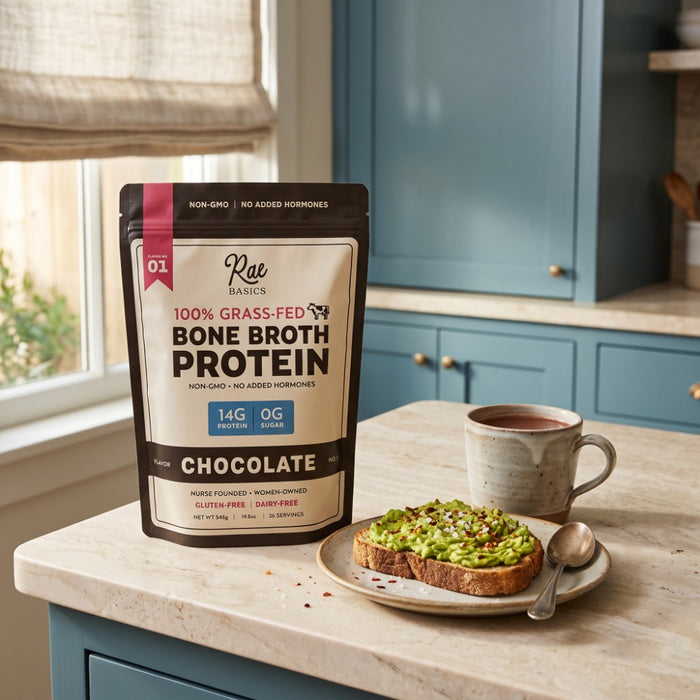
It usually doesn't. Bone broth protein has no lactose or whey, two of the most common reasons protein drinks cause bloating and gas. When someone does feel bloated after a scoop, it's usually from drinking it too fast, from sugar alcohols or added fibers and gums in the mix, or from a stomach that needs a few days to adjust.
In this article
I hear this one a lot, usually from women who gave up on protein shakes because of how they felt afterward. Below is what actually causes the bloat, what bone broth protein changes and what it doesn't, and how I'd start if your stomach is sensitive.
Does bone broth protein make you bloated?
Bone broth protein is made from beef bones and connective tissue simmered into broth and then dried. Most of the protein is collagen and its building blocks. There's no milk in it, so there's no lactose (the milk sugar a lot of adults don't digest well) and no whey or casein (the milk proteins). If your bloating comes from dairy, that alone can make a real difference.
That doesn't mean nobody ever feels bloated after a scoop. Any new food can take some getting used to, and the other ingredients in a mix matter as much as the protein. Bone broth protein isn't a common cause of bloating, but the whole recipe, and how fast you drink it, still count.
Why some protein drinks cause gas
According to the NIH's National Institute of Diabetes and Digestive and Kidney Diseases (NIDDK), gas comes from two places. One is air you swallow. The other is bacteria in your large intestine breaking down carbohydrates your small intestine didn't fully digest. Protein drinks can set off both.
- Lactose. NIDDK estimates that about 36 percent of people in the United States have lactose malabsorption. Many whey concentrates and milk-based shakes still carry some lactose.
- Sugar alcohols. NIDDK lists sweeteners ending in "-ol," like sorbitol, xylitol, erythritol and maltitol, among foods that can cause gas. They show up in a lot of low-sugar protein products.
- Added fiber and gums. Too much fiber gives some people more gas, and plenty of shakes add fiber for texture or "gut health."
- Speed and air. Chugging a cold, frothy shake through a straw means swallowing a lot of air. If gas bothers you, NIDDK suggests eating and drinking slowly and cutting back on straws and fizzy drinks.
Is bone broth protein easy to digest?
For a lot of people, yes. It's one of the main reasons customers tell us they switched, and many of them came to us after whey left them bloated. I can't promise how your stomach will respond, but I can tell you exactly what's in the cup.
Our grass-fed Bone Broth Protein Mix is dairy-free and gluten-free. The creaminess comes from organic coconut milk and organic oat milk. It's sweetened with organic monk fruit, not a sugar alcohol, and it has 0g sugar. There's no added fiber or gum on the ingredient list. Each 21g scoop has 14g of protein and 10g+ of naturally occurring collagen. You can see the full ingredient list for every flavor on our Rae Basics facts page.
It does contain coconut, so skip it if you have a coconut allergy. And if dairy is the reason you're reading this, our guide to whether bone broth protein is dairy free goes deeper on reading labels.
Bone broth protein side effects: diarrhea, upset stomach and more
Side effects aren't common. Here's what I'd tell a friend.
Upset stomach or nausea
This tends to happen when a protein drink goes down on a completely empty stomach, very fast or very hot. Sip it over about 10 minutes, or have it with a little food.
Loose stools
A sudden jump in protein, a new sweetener or a lot of extra fluid at once can all do this for a day or two. If it keeps happening, stop and look at what else changed, like a new milk, a new supplement or more coffee than usual.
Headaches or flushing
A small number of people say they react to long-simmered broths. This is often linked to histamine intolerance, which researchers describe as a mismatch between the histamine you take in from food and your body's ability to break it down. Aged, fermented and cured foods are the best-known triggers, and research on broths specifically is thin (Comas-Basté and colleagues, 2020). If you already know you react to those foods, start very small and talk to your clinician first.
How to start if your stomach is sensitive
This is the routine I suggest to anyone who's nervous about a new protein.
- Start with half a scoop for the first three to five days, then move up to a full scoop.
- Drink it warm, not scalding, and sip it. A warm drink slows you down on its own.
- Mix it with water or a milk you already tolerate. If you're testing whether the Mix works for you, don't switch milks the same week.
- Make a paste first. Stir the scoop into two tablespoons of hot liquid before adding the rest so it dissolves fully and there are no clumps to gulp. It's the method in our Protein Hot Chocolate recipe.
- Have it with food the first week: a piece of toast, an egg, some fruit.
- Change one thing at a time. Start magnesium, a new probiotic and a new coffee in the same week and you'll never know what helped or what didn't.
“If someone has a sensitive stomach, I always tell them to start with a smaller serving and see how they feel, but I love that our formula is so simple and doesn't contain whey, dairy or gluten.”
Skotie Rae, RN, founder
If you're a coffee person, a scoop in your mug is another easy way in. Our guide to putting bone broth protein in coffee shows how to keep it smooth. If you'd rather test it as a cozy evening drink, start with our bone broth hot chocolate guide.
When bloating is a reason to call your clinician
Some gas is normal. Wearing my nurse hat, though, I'd want you to check in with your clinician if:
- the bloating is new and doesn't go away
- it comes with pain, weight loss you didn't plan, blood in your stool, vomiting or fever
- it happens after almost everything you eat
Those deserve a real conversation with someone who can examine you. Swapping to another product won't sort them out.
Quick answers
Does bone broth protein make you gassy?
It's not a common cause of gas, because it has no lactose or whey. Gas usually comes from drinking too fast, sugar alcohols, added fibers, or a stomach getting used to something new.
Is bone broth protein easier to digest than whey?
Many people find it is, especially if dairy bothers them. Bone broth protein has no lactose, whey or casein. Everyone's different, so start with half a scoop and see how you feel.
Can bone broth protein cause diarrhea?
It's uncommon. A sudden increase in protein, a new sweetener or a lot of extra fluid can loosen stools for a day or two. If it keeps happening, stop and check what else changed.
What sweetener is in Rae Basics Bone Broth Protein Mix?
Organic monk fruit. There are no sugar alcohols, and each scoop has 0g sugar.
How much should I start with?
Half a scoop a day for three to five days, then a full scoop. Sip it warm, and for the first week, have it with a little food.
Sources
- National Institute of Diabetes and Digestive and Kidney Diseases. Symptoms and Causes of Gas in the Digestive Tract.
- National Institute of Diabetes and Digestive and Kidney Diseases. Eating, Diet, and Nutrition for Gas in the Digestive Tract.
- National Institute of Diabetes and Digestive and Kidney Diseases. Definition and Facts for Lactose Intolerance.
- Comas-Basté O, Sánchez-Pérez S, Veciana-Nogués MT, Latorre-Moratalla M, Vidal-Carou MC. Histamine intolerance: the current state of the art. Biomolecules. 2020;10(8):1181.