Magnesium doesn't treat menopause, and the evidence doesn't support it for hot flashes. What it can do is help you reach a daily mineral target many women miss from food alone, and it may support muscle relaxation and a calmer evening routine in perimenopause, when sleep often gets harder. Women 31 and older need 320mg a day from food and supplements combined, and the upper limit for supplements alone is 350mg a day.
In this article
I'll stick to what the evidence supports, even where it's disappointing. (For the bigger picture beyond menopause, see magnesium glycinate for women over 40.) Below: what magnesium can and can't do in these years, how much you need, and when to check with your clinician first.
Why magnesium comes up in perimenopause
The years leading up to menopause, called perimenopause or the menopausal transition, can bring hot flashes, night sweats, trouble sleeping, joint and muscle aches, mood changes and trouble concentrating, according to the National Institute on Aging. Some women barely notice. Others get most of the list.
Magnesium comes up because it's involved in several of those systems. The NIH Office of Dietary Supplements describes it as a cofactor in more than 300 enzyme systems, including the ones for muscle and nerve function, and notes that an adult body holds about 25 grams of magnesium, more than half of it in the bones. That makes it a reasonable nutrient to pay attention to in midlife. It doesn't mean it will make any one symptom go away.
Can magnesium help with hot flashes?
The best current evidence says no. In 2023, The North American Menopause Society (now The Menopause Society) published a position statement reviewing nonhormone options for hot flashes and night sweats. The panel did not recommend supplements or herbal remedies for these symptoms. It named hormone therapy as the most effective treatment, with several prescription and behavioral options for women who can't or would rather not use hormones (The North American Menopause Society, 2023).
If hot flashes are wrecking your days or nights, bring it up with your clinician, because there are options that work. Caffeine is worth a look too. In a Mayo Clinic survey, caffeine use was linked with more bothersome hot flashes in postmenopausal women (Faubion and colleagues, 2015). Our guide to caffeine in hot chocolate, mocha and coffee has the numbers if you want to cut back slowly.
Magnesium and sleep in the menopause years
Sleep is one of the top reasons women reach for magnesium. The research isn't settled. A 2023 systematic review found the evidence on magnesium and sleep limited and mixed, and said better trials are needed (Arab and colleagues, 2023).
My practical take: magnesium glycinate may support a calmer wind-down alongside good sleep habits, and most people find it easy on the stomach. Give a steady routine a few weeks before you decide whether it's doing anything. And if you're waking up drenched in sweat, the real sleep problem is usually the night sweats, which is a clinician conversation. Our guide on when to take magnesium glycinate covers timing, and magnesium for sleep compares the forms.
Leg cramps and bone health
Night leg cramps are one of the most common reasons people try magnesium, and I wish the evidence were better. A 2020 Cochrane review found magnesium is unlikely to give clinically meaningful protection from muscle cramps in older adults (Garrison and colleagues, 2020). Results for pregnancy-related cramps were conflicting. If cramps are your main reason, keep expectations modest, and tell your clinician if they're frequent, painful or new, since some medicines and conditions cause them.
Bones are a different story, though still not a supplement story. Bone density matters more after menopause, and the NIH notes that magnesium is essential for bone health and that some studies link higher magnesium intake with higher bone mineral density. It also says more research is needed to know whether magnesium supplements help prevent or manage osteoporosis.
So get enough magnesium, food first, alongside the calcium, vitamin D, protein and strength training your clinician recommends. A supplement can fill a gap in that plan, but it can't replace the rest of it.
Protein is the piece of that plan many women run short on at breakfast. A mug of Bone Broth Protein Mix adds 14g in the morning and sits fine alongside an evening magnesium habit. See protein in the morning, magnesium at night for a sample day.
How much magnesium do women need in perimenopause and menopause?
These targets come from the NIH Office of Dietary Supplements and count magnesium from food and supplements together:
| Group | Daily target |
|---|---|
| Women 19 to 30 | 310mg |
| Women 31 and older | 320mg |
| Upper limit from supplements (adults) | 350mg |
Food comes first, and a handful of foods do a lot of the work. Per the NIH: pumpkin seeds have 156mg per ounce, chia seeds 111mg per ounce, almonds 80mg per ounce and boiled spinach 78mg per half cup. A day with a small handful of pumpkin seeds, chia in your oats and spinach at dinner gets you most of the way to 320mg.
If you add a supplement, 200mg of elemental magnesium stays under the 350mg supplement limit. Magnesium from food doesn't count toward that limit.
Which kind of magnesium to choose
Magnesium glycinate (also called bisglycinate) is the form most people pick for evenings because it tends to be gentle on the stomach. The catch is that plenty of "glycinate" labels are buffered, meaning part of the magnesium is actually magnesium oxide. Our guide to buffered vs non-buffered magnesium glycinate shows how to spot that on a Supplement Facts panel.
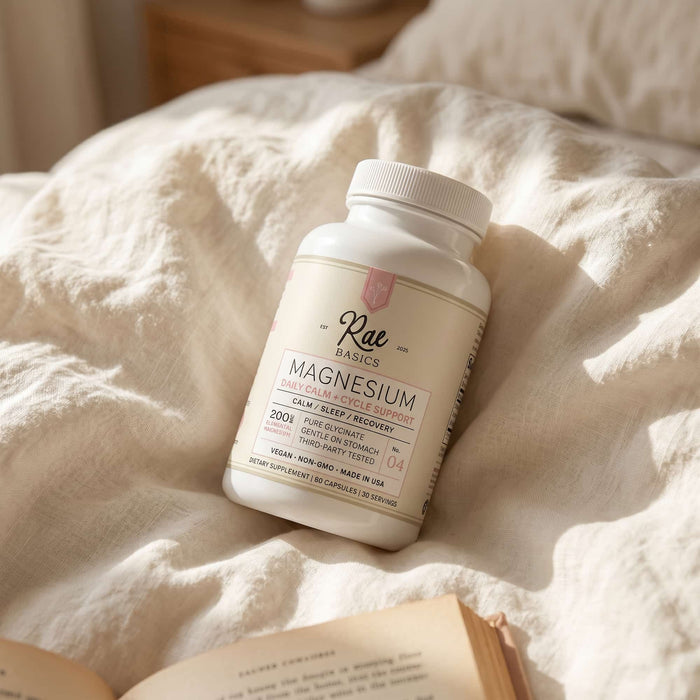
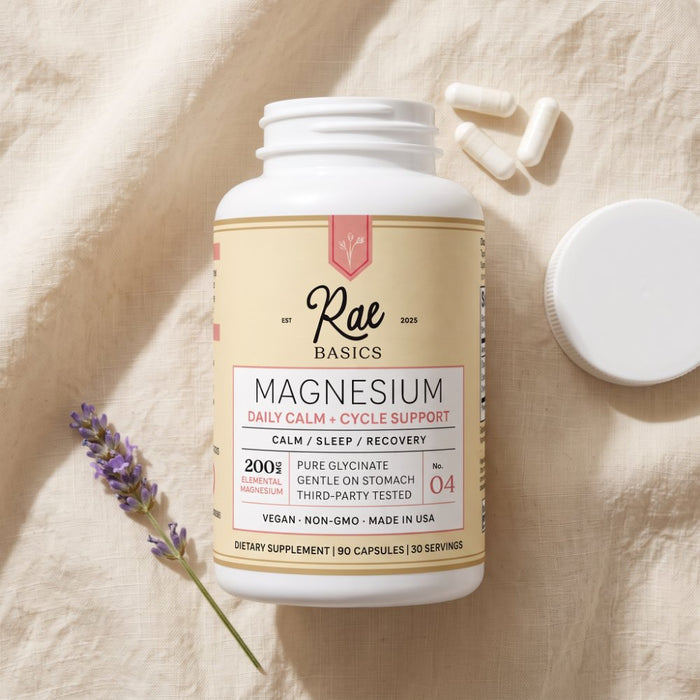
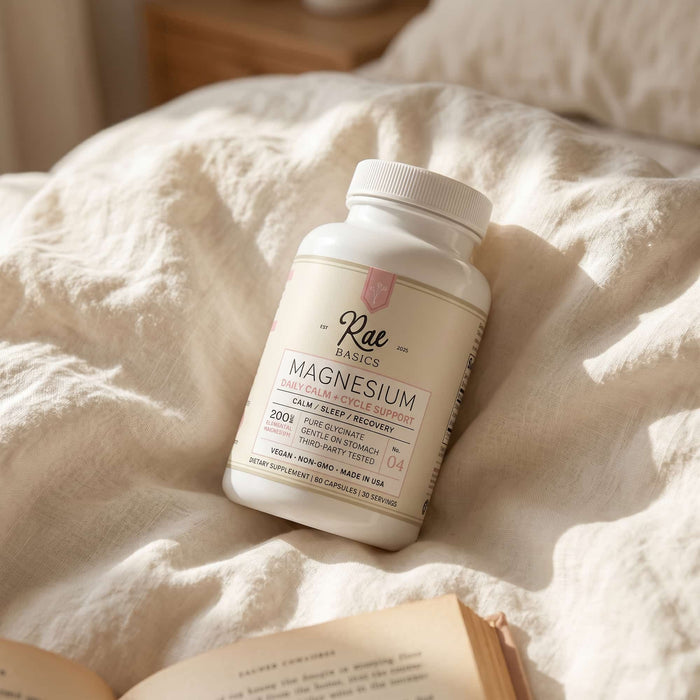
I built our NO. 04 Magnesium Glycinate to pass my own label check: 200mg of elemental magnesium from non-buffered magnesium bisglycinate, three capsules per serving, and three ingredients total (magnesium bisglycinate, tapioca starch and a vegetable (HPMC) capsule). Every lot is third-party tested, and the certificate is on our Certificate of Analysis page. Full details are on Rae Basics at a glance.
“I think magnesium is an important nutrient for women at every stage of life, which is why we wanted NO. 04 to be a simple, high-quality magnesium glycinate that women can easily add to their daily routine.”
Skotie Rae, RN, founder
If your evenings include a warm drink, a caffeine-free mug from our Classic Chai Latte recipe fits right into the routine.
Talk with your clinician first if
- You have kidney disease. Your kidneys clear extra magnesium, and reduced kidney function changes what's safe.
- You take bisphosphonates for bone density. The NIH advises taking them at least 2 hours apart from magnesium.
- You take tetracycline or quinolone antibiotics, diuretics or acid-reducing medicines (PPIs), which can interact with magnesium or change your levels.
- You're on hormone therapy or another prescription for menopause symptoms and want to add supplements. Bringing the bottle to your appointment is always fine.
Quick answers
Does magnesium help with menopause symptoms?
It isn't a treatment for menopause symptoms. It may support muscle relaxation and a calmer evening routine, but the evidence doesn't support supplements for hot flashes. Talk with your clinician about symptoms that bother you.
How much magnesium should a woman over 50 take?
Women 31 and older need 320mg a day from food and supplements combined. The upper limit for supplemental magnesium is 350mg a day for adults, not counting food.
Is magnesium glycinate good for perimenopause sleep?
It may support a calmer wind-down, and a lot of women like it in the evening. Research on magnesium and sleep is still limited and mixed, so treat it as one part of good sleep habits.
Can magnesium help with night leg cramps?
A 2020 Cochrane review found magnesium is unlikely to meaningfully prevent muscle cramps in older adults. Tell your clinician about frequent or painful cramps.
What form of magnesium is NO. 04?
Non-buffered magnesium bisglycinate, 200mg of elemental magnesium per 3 capsules, with no magnesium oxide.
Sources
- NIH Office of Dietary Supplements. Magnesium: Fact Sheet for Health Professionals.
- National Institute on Aging. What Is Menopause?
- The North American Menopause Society. The 2023 nonhormone therapy position statement of The North American Menopause Society. Menopause. 2023;30(6):573-590.
- Arab A, Rafie N, Amani R, Shirani F. The role of magnesium in sleep health: a systematic review of available literature. Biol Trace Elem Res. 2023;201(1):121-128.
- Garrison SR, Korownyk CS, Kolber MR, et al. Magnesium for skeletal muscle cramps. Cochrane Database Syst Rev. 2020;9(9):CD009402.
- Faubion SS, Sood R, Thielen JM, Shuster LT. Caffeine and menopausal symptoms: what is the association? Menopause. 2015;22(2):155-158.