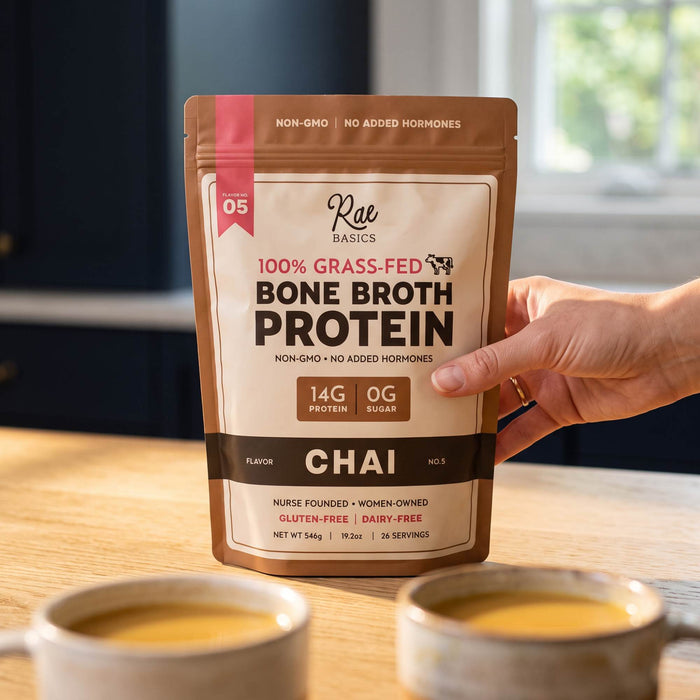
Hot chocolate has very little caffeine: about 5mg in a homemade mug made with milk, according to USDA data, compared with about 95mg in an 8 oz cup of brewed coffee. A café mocha usually lands between 63mg and 126mg, depending on how many espresso shots go in. Of our flavors, only Caffeinated Chocolate has caffeine (60mg per scoop); Classic Chocolate, Mocha and Chai have 0mg.
In this article
I'll go through the full comparison, what "natural caffeine" actually means, and what I tell women in perimenopause who are rethinking their coffee.
Caffeine in hot chocolate vs coffee: the side-by-side
These are typical amounts. Brew strength, cup size and brand all change the numbers, so use them as a guide rather than a lab result for your own mug.
| Drink | Serving | Caffeine |
|---|---|---|
| Brewed coffee | 8 oz | About 95mg |
| Brewed coffee, coffee-shop size | 12 oz | 113 to 247mg |
| Espresso | 1 oz shot | About 63mg |
| Café mocha or latte | 1 or 2 shots | About 63 to 126mg |
| Decaf coffee | 8 oz | 2 to 15mg |
| Green tea | 8 oz | About 29mg |
| Homemade hot cocoa with milk | 1 cup | About 5mg |
| Cocoa mix made with water | 6 oz | About 4mg |
| Caffeinated Chocolate Bone Broth Protein Mix | 1 scoop (21g) | 60mg |
| Classic Chocolate, Mocha or Chai Bone Broth Protein Mix | 1 scoop (21g) | 0mg |
Coffee, green tea and cocoa figures come from USDA FoodData Central. The 12 oz coffee and decaf figures come from the FDA. Our numbers come from our own Nutrition Facts panels.
How much caffeine is in a mocha?
A café mocha is espresso, chocolate and steamed milk, so nearly all of its caffeine comes from the espresso. One shot puts it around 63mg and two shots around 126mg. Order a large with an extra shot and you can pass a cup of drip coffee fast.
Our Mocha works differently. It gets its coffee taste from organic coffee flavor, not espresso, and it has 0mg of caffeine. So the caffeine in your cup depends entirely on what you mix it into:
- Mocha with hot water or milk: 0mg. A mocha taste you can have at 9 p.m.
- Mocha stirred into 8 oz of coffee: about 95mg, all from the coffee.
- Caffeinated Chocolate stirred into 8 oz of coffee: about 155mg, the coffee plus 60mg.
That last one is what I reach for on 5 a.m. days, and it's the Morning Boost recipe on our recipes page. If you want the coffee taste with no caffeine, the Evening Mocha Latte uses Mocha and no coffee at all.
Does hot chocolate have caffeine?
Regular hot chocolate has a little. Cocoa beans naturally contain some caffeine plus a milder relative called theobromine. By USDA figures, a tablespoon of unsweetened cocoa powder has about 12mg of caffeine and about 111mg of theobromine, and a homemade cup of cocoa has about 5mg of caffeine. Darker, more concentrated chocolate carries more. Even at the high end, it's a small fraction of a cup of coffee.
Our flavors are simpler to track. Classic Chocolate, Mocha and Chai have 0mg of caffeine per scoop. Caffeinated Chocolate is the only one with caffeine, and all 60mg of it is added on purpose from green coffee beans.
What does "natural caffeine" mean?
Green coffee beans are just coffee beans before roasting. "Natural" tells you where the caffeine came from. It doesn't mean your body handles it differently: the FDA says there's no difference in how the body processes caffeine that occurs naturally in coffee or tea and caffeine added to a product. Count it like any other caffeine.
What 60mg does give you is a smaller dose than a standard cup, roughly two-thirds of an 8 oz brewed coffee. That's enough to take the edge off a morning without the full coffee-shop hit. For a wider comparison, see protein hot chocolate vs coffee vs matcha or the best coffee alternatives for energy.
How much caffeine is too much?
For most healthy adults, the FDA cites 400mg a day as an amount not generally associated with negative effects. That's about four or five 8 oz cups of brewed coffee. Sensitivity varies a lot, though, and some conditions and medicines make people more sensitive. If you're pregnant, trying to get pregnant, breastfeeding or on medication, the FDA recommends asking your health care provider whether you should limit caffeine.
Timing matters as much as the total. People clear caffeine at very different speeds, so if your sleep has gotten lighter, the first thing I'd try is moving your last caffeinated drink to the morning. I think of Caffeinated Chocolate as a morning cup and Classic Chocolate or Chai as the evening ones. Caffeinated Chocolate is also an adults-only flavor. The FDA notes that pediatric experts discourage caffeine for children and teens, and our guide to bone broth hot chocolate for kids covers the caffeine-free flavors.
Should you cut back on caffeine in perimenopause?
Maybe. It's worth a two-week experiment. In a Mayo Clinic survey of 1,806 women seen for menopause concerns, postmenopausal women who used caffeine rated their hot flashes and night sweats as more bothersome, on average, than those who didn't (Faubion and colleagues, 2015). A survey like this shows an association, not proof that caffeine causes symptoms, and plenty of women drink coffee with no trouble at all.
If your nights feel rougher lately, keep caffeine to the morning, swap your second cup for something with less, and see how you feel. Trading one 95mg coffee for Caffeinated Chocolate drops about 35mg. Trading it for Mocha drops all of it. And if symptoms are affecting your sleep or your days, bring it up with your clinician. There are good options to talk through.
Stepping down from coffee, one cup at a time
Most women I talk to don't want to quit coffee. They want to stop feeling wired at 10 a.m. and flat at 2 p.m. Stepping down one cup at a time is the easiest way I know:
- Keep your first coffee. Replace the second with a scoop of Caffeinated Chocolate (95mg becomes 60mg).
- After a week or two, replace the afternoon drink with Mocha (0mg, same mocha taste).
- In the evening, make Classic Chocolate or Chai with warm milk.
Each of those cups also has 14g of protein and 0g sugar from our grass-fed Bone Broth Protein Mix, which helps if coffee has been standing in for breakfast. Our guide to putting bone broth protein in coffee shows how to mix it without clumps.
“I haven't completely given up caffeine, but I've cut back a lot, and I love having Caffeinated Chocolate as an option when I want something different.”
Skotie Rae, RN, founder
Quick answers
How much caffeine is in hot chocolate?
Very little. A homemade cup of hot cocoa has about 5mg of caffeine, and cocoa mix made with water has about 4mg per 6 oz, according to USDA data. A cup of brewed coffee has about 95mg.
Does a mocha have more caffeine than coffee?
Usually not. A café mocha with one espresso shot has about 63mg, and a two-shot mocha about 126mg, compared with about 95mg in 8 oz of brewed coffee. Bigger sizes and extra shots change the math.
Is Mocha caffeinated?
No. Mocha gets its taste from coffee flavor and has 0mg of caffeine. If you stir it into coffee, the caffeine comes from the coffee.
How does Caffeinated Chocolate compare with a cup of coffee?
One 21g scoop has 60mg of caffeine from green coffee beans, about two-thirds of the 95mg in an 8 oz cup of brewed coffee.
Where can I see the full nutrition facts?
Every number for every flavor is on one page: Rae Basics at a glance.
Sources
- U.S. Department of Agriculture, FoodData Central. Beverages, coffee, brewed, prepared with tap water (FDC ID 171890). 40mg caffeine per 100g; about 95mg per 8 fl oz cup.
- U.S. Department of Agriculture, FoodData Central. Beverages, coffee, brewed, espresso, restaurant-prepared (FDC ID 171891). About 63mg caffeine per 1 fl oz.
- U.S. Department of Agriculture, FoodData Central. Milk, chocolate beverage, hot cocoa, homemade (FDC ID 171277). About 5mg caffeine per cup.
- U.S. Department of Agriculture, FoodData Central. Cocoa, dry powder, unsweetened (FDC ID 169593). About 12mg caffeine and 111mg theobromine per tablespoon.
- U.S. Department of Agriculture, FoodData Central. Beverages, tea, green, brewed, regular (FDC ID 171917). About 12mg caffeine per 100g, or about 29mg per 8 fl oz cup.
- U.S. Food and Drug Administration. Spilling the Beans: How Much Caffeine Is Too Much?
- Faubion SS, Sood R, Thielen JM, Shuster LT. Caffeine and menopausal symptoms: what is the association? Menopause. 2015;22(2):155-158.