No single type of magnesium has been proven best for sleep. Magnesium glycinate is the most common evening pick because it's well absorbed and gentle on the stomach. The sleep research is promising but thin: a few small trials, mostly in older adults, found modest benefits, like falling asleep about 17 minutes sooner on average.
In this article
With three boys in the house, I value sleep as much as anyone, and as a nurse I don't want to oversell anything that promises more of it. Here's what the research shows, how the forms compare (the full breakdown is in magnesium glycinate vs citrate vs oxide), how magnesium differs from melatonin, and a realistic evening routine.
Does magnesium really help sleep?
Your body uses magnesium in more than 300 enzyme systems, including ones involved in muscle and nerve function, according to the NIH Office of Dietary Supplements. It isn't a sedative. What researchers want to know is whether getting enough of it supports better sleep, and so far the answer is "maybe, a little."
A 2023 systematic review found that observational studies link better magnesium status with better sleep, but clinical trials are few and their results are mixed (Arab and colleagues, 2023).
A 2021 meta-analysis pooled three randomized trials in 151 older adults with trouble sleeping. People taking magnesium fell asleep about 17 minutes sooner than people on placebo. Total sleep time went up by about 16 minutes, but that difference wasn't statistically significant, and the authors rated the overall evidence as low quality (Mah and Pitre, 2021).
The trial you'll see cited most often gave 46 older adults 500mg of magnesium a day for 8 weeks, and several sleep measures improved compared with placebo (Abbasi and colleagues, 2012). That dose is above the 350mg upper limit for supplemental magnesium, which is one reason studies like this are run under supervision.
My read: magnesium may support a calmer evening and somewhat better sleep for some people, especially if they don't get much from food. It's one part of good sleep, and it won't carry the whole load.
“Magnesium plays a role in the body's relaxation and nervous system function, which is one reason I love taking magnesium glycinate before bed. It's a simple way to support your body as you wind down for the night.”
Skotie Rae, RN, founder
What type of magnesium is best for sleep?
I'm not aware of any trial comparing forms head to head for sleep, so the choice comes down to absorption and how your stomach handles it.
| Form | For an evening routine |
|---|---|
| Glycinate (bisglycinate) | The most popular choice: well absorbed and usually gentle on the stomach |
| Citrate | Well absorbed, but its laxative effect is not what most people want at bedtime |
| Oxide | Poorly absorbed and the most likely to upset the stomach |
| Threonate | Marketed for the brain; very little magnesium per capsule and early research |
| Taurate or malate | Reasonable forms with little sleep-specific research |
Glycinate has one small bonus at night. The magnesium is bound to glycine, an amino acid with a bit of sleep research of its own. Those studies used about 3 grams of glycine, at least twice what a 200mg serving of magnesium glycinate carries, so I'd call it a nice extra and not a reason to buy. If you go with glycinate, make sure it's non-buffered, meaning it isn't cut with oxide. Our guide to buffered vs non-buffered magnesium glycinate shows you how to check the label.
Magnesium glycinate or threonate for sleep?
Threonate gets a lot of attention online. It's interesting, but it delivers very little elemental magnesium per capsule, costs more, and the human research is still early. Glycinate gives you more magnesium per dollar and is generally easy on the stomach. For a nightly habit, I'd pick glycinate.
Magnesium vs melatonin: what's the difference?
They do completely different jobs. Melatonin is a hormone your brain makes in response to darkness. The NIH's National Center for Complementary and Integrative Health (NCCIH) says it may help with jet lag, but there isn't enough strong evidence to recommend it for ongoing sleep problems. NCCIH also reports that in a 2023 study, 22 of 25 melatonin gummy products were inaccurately labeled.
Magnesium is a nutrient. It doesn't set your body clock. It covers a mineral a lot of adults don't get enough of, which may support a calmer wind-down over a few weeks.
Some people take both. There's little research on the combination, so ask your clinician or pharmacist first, especially if you take prescription sleep or mood medicines.
How much magnesium for sleep?
Adult women need 310 to 320mg of magnesium a day from food and supplements combined. The NIH sets the upper limit for supplemental magnesium at 350mg a day for adults, and food doesn't count toward that limit. A supplement with 200mg of elemental magnesium sits well under it and leaves room for magnesium-rich foods like pumpkin seeds, almonds, spinach and beans. Compare the elemental number on labels, not the weight of the whole compound.
Check with your clinician first if you have kidney disease, are pregnant or breastfeeding, or take medicines such as certain antibiotics, osteoporosis drugs, diuretics or acid reducers.
Why magnesium for sleep might not seem to work
- It's only been a few days. The studies ran for weeks. Give a steady routine three to four weeks.
- It's oxide, or buffered. Read the label.
- The timing is off. Groggy in the morning? Take it with dinner instead. See when to take magnesium glycinate.
- Caffeine. In one controlled study, 400mg of caffeine disrupted sleep even when taken 6 hours before bed, and the researchers advise skipping substantial caffeine for at least 6 hours before bedtime (Drake and colleagues, 2013). A supplement can't cancel out an afternoon latte.
- Something else is going on. Snoring, waking up gasping, hot flashes, pain or low mood deserve a real conversation with your clinician.
My simple evening routine
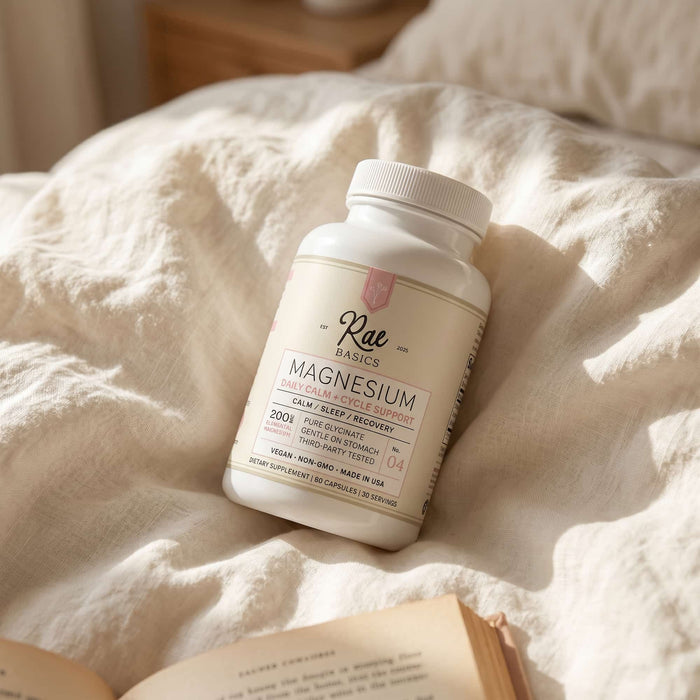
This is what I actually recommend: caffeine done by early afternoon, dinner, then three capsules of NO. 04 Magnesium Glycinate with water 30 to 60 minutes before bed. That's 200mg of elemental magnesium from Chelamax non-buffered bisglycinate, no oxide, third-party tested, with a published Certificate of Analysis. Then lights low and phone down.
If you like something warm at night, a cup of Classic Chocolate Bone Broth Protein Mix has 0mg caffeine, 14g of protein and 0g sugar. My own evening cup is the Classic Chai Latte from our recipes page: warm, spiced, no caffeine. Every product fact is on our Rae Basics facts page.
The other half of my routine happens at breakfast. A scoop of Bone Broth Protein Mix in coffee or warm milk gets 14g of protein into the meal most women skip, and it doesn't interfere with your evening magnesium. Here's how I pair the two across the day.
Quick answers
What type of magnesium is best for sleep?
No form has been proven best. Glycinate is the most popular evening choice because it's well absorbed and gentle on the stomach. Choose a non-buffered one so it isn't cut with oxide.
Does magnesium really help you sleep?
Possibly, a little. Small trials in older adults found people fell asleep about 17 minutes sooner on average, but the evidence is limited and low quality. Think of it as support for good sleep habits.
Is magnesium better than melatonin?
They're different. Melatonin is a hormone that signals darkness; magnesium is a mineral your body needs every day. Ask your clinician before combining them.
How much magnesium should I take for sleep?
Stay within the 350mg a day upper limit for supplemental magnesium. Many people use about 200mg of elemental magnesium in the evening, alongside magnesium-rich foods.
How long does magnesium take to help sleep?
The studies ran for several weeks. Take it at the same time every night for three to four weeks before you judge it.
Sources
- NIH Office of Dietary Supplements. Magnesium: Fact Sheet for Health Professionals.
- Arab A, Rafie N, Amani R, Shirani F. The role of magnesium in sleep health: a systematic review of available literature. Biol Trace Elem Res. 2023;201(1):121-128.
- Mah J, Pitre T. Oral magnesium supplementation for insomnia in older adults: a systematic review and meta-analysis. BMC Complement Med Ther. 2021;21(1):125.
- Abbasi B, Kimiagar M, Sadeghniiat K, et al. The effect of magnesium supplementation on primary insomnia in elderly: a double-blind placebo-controlled clinical trial. J Res Med Sci. 2012;17(12):1161-1169.
- National Center for Complementary and Integrative Health. Melatonin: What You Need To Know.
- Drake C, Roehrs T, Shambroom J, Roth T. Caffeine effects on sleep taken 0, 3, or 6 hours before going to bed. J Clin Sleep Med. 2013;9(11):1195-1200.