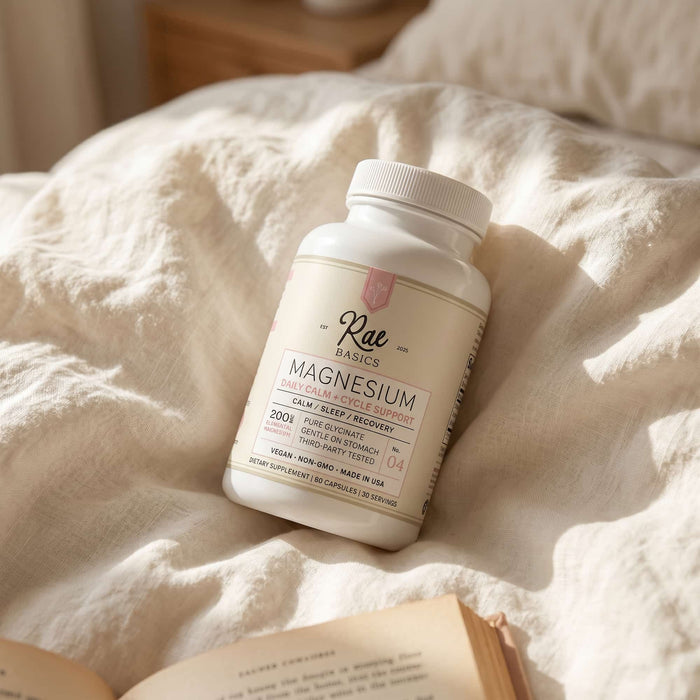
The broth protein itself has almost no carbohydrate, so bone broth protein can fit a keto diet. What decides it is everything added for flavor. One 21g scoop of Rae Basics Bone Broth Protein Mix has 3g of carbs (4g for Chai), 0g sugar and 14g of protein, sweetened with monk fruit, so a mug takes a small bite out of a typical keto limit of under 50g of carbs a day.
In this article
- How many carbs are in bone broth protein?
- Will bone broth protein kick you out of ketosis?
- The milk you choose matters more than the scoop
- What is monk fruit, and is it keto?
- How to read any "keto" protein label
- Is bone broth protein a good choice on keto?
- Keto-friendly ways to drink it
- Quick answers
- Sources
Here's the flavor-by-flavor math, what "keto" actually means, where monk fruit fits, and the milk choice that matters more than the scoop.
How many carbs are in bone broth protein?
Plain bone broth protein is mostly protein. In a flavored mix, the carbs come from whatever makes it taste like hot chocolate or chai. In ours, that's cocoa, oat milk and coconut milk. These numbers are per scoop, straight from our Nutrition Facts panels.
| Flavor | Carbs | Sugar | Protein | Fat | Calories |
|---|---|---|---|---|---|
| Classic Chocolate | 3g | 0g | 14g | 2.5g | 80 |
| Mocha | 3g | 0g | 14g | 2.5g | 80 |
| Caffeinated Chocolate | 3g | 0g | 14g | 2.5g | 80 |
| Chai | 4g | 0g | 14g | 2g | 90 |
Dietary fiber is 0g in every flavor, so if you count net carbs, net and total are the same number here. One label note: a serving is one 21g scoop. Some older bags print 26g, but the current scoop is 21g, so go by the scoop in your bag.
“Rae Basics has 0g sugar, 3g carbs and 80 calories per scoop.”
Skotie Rae, RN, founder
That's Classic Chocolate, Mocha and Caffeinated Chocolate. Chai is a little higher, at 4g of carbs and 90 calories per scoop, still with 0g sugar.
Will bone broth protein kick you out of ketosis?
Very unlikely on its own. Ketogenic diets are usually defined as cutting carbohydrate to under 50g a day (Paoli and colleagues, 2013), and a lot of people on a strict plan aim lower. At 3g to 4g a scoop, one mug is a small part of that budget.
Protein is the other number keto plans watch. A well-formulated ketogenic diet keeps protein moderate rather than unlimited (Batch and colleagues, 2020), and 14g in a mug fits comfortably inside most plans. If you're on a medically supervised ketogenic diet, for example one set up by a neurologist or a registered dietitian, check with that team before adding anything. Those plans are calculated precisely.
The milk you choose matters more than the scoop
This is the part people miss. The Mix is made to taste good with just water, but most of us make it with milk, and milk has its own carbs. According to USDA data:
- Whole dairy milk: about 12g of carbs and 8g of protein per cup, nearly all of the carbs from natural milk sugar.
- Unsweetened almond milk: about 3g of carbs and 1g of protein per cup.
- Water: 0g.
So a scoop of Classic Chocolate in 10 oz of whole milk comes to roughly 18g of carbs. The same scoop in unsweetened almond milk is roughly 7g, and in water it's 3g. On keto, I'd use water, unsweetened almond milk or a splash of cream, and skip oat milk and sweetened plant milks.
What is monk fruit, and is it keto?
Monk fruit, also called luo han guo, is a small round fruit whose extract is intensely sweet. The FDA lists extracts of Siraitia grosvenorii (monk fruit) among the high-intensity sweeteners used in the U.S. food supply and notes that sweeteners like these add few or no calories and generally won't raise blood sugar. That's how a scoop can taste like hot chocolate with 0g sugar.
The FDA also says an Acceptable Daily Intake hasn't been specified for monk fruit, which can happen when there's evidence of safety at levels well above what's needed to sweeten food. For keto, monk fruit doesn't count as sugar and adds no meaningful carbs.
How to read any "keto" protein label
"Keto" on the front of a bag is a marketing word. The answer is on the back. This is the checklist I use.
- Total Carbohydrate and Dietary Fiber. If a label advertises low net carbs, check both lines yourself.
- Total Sugars. You want 0g or close to it.
- The sweetener. Monk fruit and stevia add no meaningful carbs. Sugar alcohols like erythritol, maltitol and sorbitol are common in keto products. A systematic review found they're poorly absorbed in a dose-dependent way, which is why bigger amounts can cause gas or loose stools in some people (Lenhart and Chey, 2017). Maltodextrin, a common filler, is a carbohydrate.
- Serving size. Compare products per scoop, not per bag.
- Protein source. Know what you're drinking: bone broth, collagen, whey or plant.
Our Classic Chocolate ingredient list is grass-fed bone broth, organic cocoa powder, organic coconut milk, organic oat milk, organic monk fruit, organic chocolate flavor and Redmond's pink salt. There are no sugar alcohols and no maltodextrin. You can see every flavor's list on Rae Basics at a glance.
Is bone broth protein a good choice on keto?
It can be a useful one. You get a warm, sweet-tasting drink with 0g sugar that's dairy-free and gluten-free, and it adds protein without a blender. For a lot of people on keto, the hardest thing to give up is the sweet drink, and this can take its place.
There are two things I'd want you to know, though. Bone broth protein is rich in collagen amino acids like glycine and proline and naturally low in some essential ones, such as tryptophan. It should be one protein in your day, not the only one, so pair it with eggs, meat, fish or full-fat Greek yogurt. And keto is a big change. Talk with your clinician first if you have diabetes or kidney disease, are pregnant, or take medicines that affect blood sugar or blood pressure.
Keto-friendly ways to drink it
- Hot: the Protein Hot Chocolate recipe with water or unsweetened almond milk. Skip the marshmallows.
- In coffee: the Morning Boost, one scoop stirred into black coffee with a splash of cream. Our guide to bone broth protein in coffee shows how to avoid clumps.
- Iced: the Iced Mocha "Proffee", made with unsweetened almond milk.
Some of our recipes aren't keto as written. The mug cake and pancakes use oat flour, and the overnight oats are, well, oats. On a low-carb day, stick to the drinks. Classic Chocolate, Mocha and Caffeinated Chocolate are all 3g of carbs a scoop, so pick whichever flavor you like best on the Bone Broth Protein Mix page. For more on the chocolate side, read is bone broth hot chocolate good for you.
Quick answers
How many net carbs are in Rae Basics Bone Broth Protein Mix?
Classic Chocolate, Mocha and Caffeinated Chocolate have 3g per scoop, and Chai has 4g. Fiber is 0g, so net carbs equal total carbs.
Does monk fruit count as sugar on keto?
No. Monk fruit extract is a high-intensity sweetener that adds no meaningful carbs, and the FDA notes that sweeteners like it generally won't raise blood sugar levels.
Is Chai keto-friendly?
Yes, at 4g of carbs and 0g sugar per scoop. It's our highest-carb flavor by 1g, so count it if you're on a strict plan.
What milk should I use on keto?
Water, unsweetened almond milk or a splash of cream. Whole dairy milk adds about 12g of carbs per cup, and oat milk is usually higher.
Is it gluten-free and dairy-free too?
Yes. Every flavor is gluten-free and dairy-free. All flavors contain coconut and are made with organic oat milk.
Sources
- Paoli A, Rubini A, Volek JS, Grimaldi KA. Beyond weight loss: a review of the therapeutic uses of very-low-carbohydrate (ketogenic) diets. Eur J Clin Nutr. 2013;67(8):789-796.
- Batch JT, Lamsal SP, Adkins M, Sultan S, Ramirez MN. Advantages and disadvantages of the ketogenic diet: a review article. Cureus. 2020;12(8):e9639.
- U.S. Food and Drug Administration. Aspartame and Other Sweeteners in Food.
- Lenhart A, Chey WD. A systematic review of the effects of polyols on gastrointestinal health and irritable bowel syndrome. Adv Nutr. 2017;8(4):587-596.
- U.S. Department of Agriculture, FoodData Central. Milk, whole (FDC ID 171265) and Beverages, almond milk, unsweetened (FDC ID 174832).