On a U.S. meat label, "grass-fed" means the cattle ate only grass and other forage after weaning, were never fed grain, and had continuous access to pasture during the growing season, according to USDA's Food Safety and Inspection Service. On bone broth protein, it tells you how the cattle were raised. It doesn't tell you how the broth was made or how much protein is in a scoop, so read the rest of the label too.
In this article
As a nurse I read labels closely, and "grass-fed" is one of the most misunderstood words on the shelf. Below is what it legally means, what it does and doesn't change in bone broth protein, and a checklist you can use on any bag, ours included.
What does "grass-fed" mean on a label?
Meat and poultry labels in the U.S. are approved by USDA's Food Safety and Inspection Service (FSIS). Its 2024 guideline on animal-raising claims says:
- "Grass Fed," "Grassfed," "Grass-Fed" and "100% Grass-Fed" all mean the same thing. The cattle were fed only forage, such as grass, after being weaned from their mother's milk.
- Grass-fed cattle can't be fed grain or grain by-products, and they must have continuous access to pasture during the growing season. Hay, silage and similar roughage count as forage, and routine vitamin and mineral supplements are allowed.
- "Grass finished" is a different claim. Grass-finished cattle can be fed grain at some point, so a truthful label might read "Grain Fed, Grass Finished."
- Partial claims have to say so, for example "Made from cattle fed grass and corn."
Companies have to submit documentation backing these claims before a label is approved. FSIS also strongly encourages third-party certification, because the agency itself can only verify so much on the farm. So a seal from an outside program is extra evidence, while the word alone rests on the producer's paperwork.
Grass-fed vs grain-fed: does it matter in bone broth protein?
For steak and ground beef, most of the nutrition research on grass-fed beef is about fat. A review of three decades of studies found grass-based diets can improve beef's fatty acid profile, with more omega-3 fats and conjugated linoleic acid (CLA) per gram of fat. It also noted grass-fed beef has a distinct flavor (Daley and colleagues, 2010).
Bone broth protein, though, is mostly protein, not fat. A scoop of our Mix has 14g of protein and just 2.5g of fat. I wouldn't buy any grass-fed bone broth protein expecting a meaningful omega-3 boost. People choose grass-fed here because of how the animals were raised and because they want to know where their food comes from. That's why we chose it too.
How is bone broth protein made?
Bone broth is made by simmering animal bones and connective tissue in water for a long time. The slow simmer pulls protein and collagen into the liquid. For a protein mix, the broth is concentrated and dried into a powder, then flavored and blended.
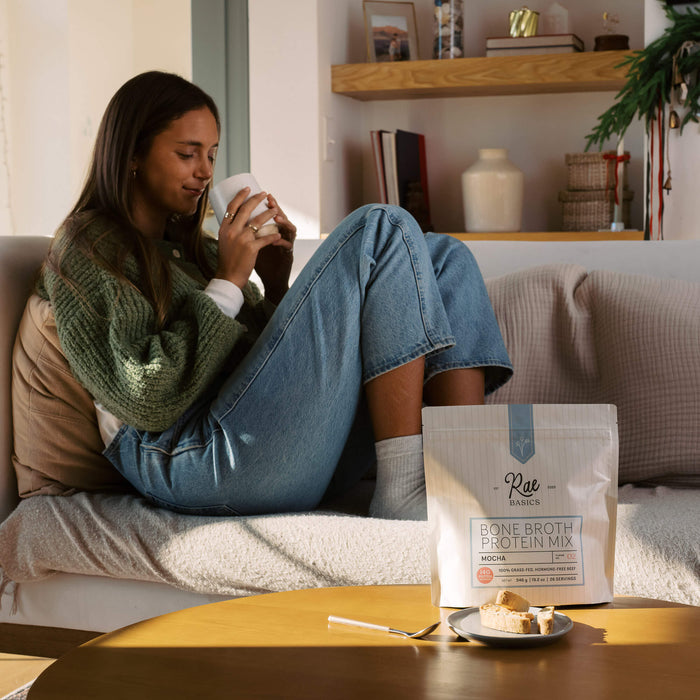
Rae Basics started in our own kitchen. During IVF I wanted something clean and comforting, and my husband Josh, a food scientist, made the first batch of bone broth hot chocolate just for me. Today the Mix is blended and packed in small batches in Utah from grass-fed beef bone broth, and our newest bags say it right on the front: 100% grass-fed, non-GMO, no added hormones.
“When we first started developing it, I kept saying I wanted something that actually tasted like a cozy cup of hot chocolate, so it would be an easy way to add bone broth to my daily routine. And I really believe we did just that.”
Skotie Rae, RN, founder
Bone broth powder vs liquid bone broth
Both start as broth, but they aren't the same in your mug. Liquid broth varies a lot. When researchers tested bone broths made from different recipes, they found big differences in the amino acids that make up collagen, with café-made broths highest and commercial ones lower than homemade versions made to the same recipe. Batches made to one standardized recipe, on the other hand, were consistent (Alcock and colleagues, 2019).
That's the practical upside of a finished powder with a Nutrition Facts panel: you know what one serving gives you. One 21g scoop of our Mix has 14g of protein and 10g+ of naturally occurring collagen, every time. I love liquid broth in soup. For a daily protein drink you can actually count, powder is easier.
How to read a bone broth protein label
Take this to the store and use it on any bag:
- Protein source. Look for the exact wording. "Grass-fed beef bone broth," "chicken bone broth," "beef protein isolate" and "collagen peptides" are all different things.
- Raising claims. "Grass-fed" should mean forage only after weaning. "Grass finished" doesn't. A third-party seal is extra evidence.
- Hormone claims. For beef, a "no hormones" claim needs documentation. For chicken, FSIS notes hormones aren't approved for poultry at all, so a "no added hormones" chicken label has to say federal regulations don't permit them.
- Protein and collagen per scoop. Compare per serving, not per bag, and check the scoop size.
- Sugar and sweetener. Look for 0g sugar, then check which sweetener is used.
- Allergens. Many creamy mixes use coconut or dairy. Ours contains coconut, and every flavor is made with organic oat milk.
The label won't tell you one more thing. Bone broth protein is rich in the amino acids found in collagen, like glycine and proline, and naturally low in some essential amino acids, tryptophan especially. It works best as one protein in your day alongside eggs, dairy, meat, fish or beans, not as your only source.
What our label says
Here's the full Classic Chocolate ingredient list: grass-fed bone broth, organic cocoa powder, organic coconut milk, organic oat milk, organic monk fruit, organic chocolate flavor and Redmond's pink salt. Per 21g scoop: 14g protein, 10g+ collagen, 0g sugar, 3g carbs, 80 calories. It's dairy-free and gluten-free.
Every flavor's ingredients and nutrition panel are on Rae Basics at a glance, and you can shop our grass-fed Bone Broth Protein Mix there too. Wondering how it tastes? Start with is bone broth hot chocolate good for you, or see how the numbers fit a low-carb plan in is bone broth protein keto. For something beyond a mug, our Chocolate Overnight Oats are a good first recipe. And if you're comparing protein types, read bone broth vs collagen peptides.
Quick answers
Is grass-fed the same as grass-finished?
No. Under FSIS guidance, grass-fed cattle eat only forage after weaning. Grass-finished cattle can be fed grain earlier in life, so the two claims aren't interchangeable.
Is grass-fed bone broth protein healthier?
The main nutrition differences in grass-fed beef are in the fat, and bone broth protein is mostly protein with little fat. Most people choose grass-fed for how the animals were raised, not for a big nutrition difference.
Does grass-fed mean organic?
No. Organic is a separate USDA certification with its own rules. A product can be grass-fed, organic, both or neither, and the label should say which.
Does bone broth protein contain added hormones?
It depends on the brand. Ours is made from grass-fed beef bone broth with no added hormones. For beef, that claim needs documentation before it can appear on an approved meat label.
How much protein is in a scoop of Rae Basics?
Each 21g scoop has 14g of protein and 10g+ of naturally occurring collagen, with 0g sugar.
Sources
- USDA Food Safety and Inspection Service. FSIS Guideline on Substantiating Animal-Raising or Environment-Related Labeling Claims (FSIS-GD-2024-0006). August 2024.
- Daley CA, Abbott A, Doyle PS, Nader GA, Larson S. A review of fatty acid profiles and antioxidant content in grass-fed and grain-fed beef. Nutr J. 2010;9:10.
- Alcock RD, Shaw GC, Burke LM. Bone broth unlikely to provide reliable concentrations of collagen precursors compared with supplemental sources of collagen used in collagen research. Int J Sport Nutr Exerc Metab. 2019;29(3):265-272.
- USDA Food Safety and Inspection Service. Meat and Poultry Labeling Terms.