

Bone broth protein is mostly collagen, so its amino acid profile is unusual. It's rich in glycine, proline, hydroxyproline and glutamic acid (which lab tests count together with glutamine), moderate in lysine and arginine, lower in leucine than dairy or meat, and has almost no tryptophan. That makes it a good addition to the rest of your diet, not a stand-alone protein.
In this article
Women who read labels as closely as I do ask me for the amino acid profile of our Bone Broth Protein Mix a lot. So here's our lab profile, what's missing, and why both matter.
Essential vs nonessential amino acids
Every protein is a chain of amino acids. Nine are essential, meaning your body can't make them and they have to come from food. The rest are called nonessential because your body can make them. Some, like glycine and glutamine, become "conditionally essential" when demand is high. Some researchers go further and argue that on a normal diet the body doesn't make quite as much glycine as it could use (Razak and colleagues, 2017).
Collagen is the most abundant protein in the body, and its makeup is lopsided. Glycine, proline and hydroxyproline together account for about 57% of the amino acids in collagen (Li and Wu, 2018). No other common protein looks like that.
Our bone broth protein's amino acid profile
This table comes from our supplier's lab amino acid profile of the grass-fed bone broth protein used in the Mix. It lists 18 amino acids, including all nine essential ones, in grams per 100g of the bone broth protein, sorted from highest to lowest. Each scoop of our Mix has about 14g of that protein, so multiply any value by 0.14 for a rough per-scoop amount.
| Amino acid | Grams per 100g of bone broth protein | Essential? |
|---|---|---|
| Glycine | 22.31 | No |
| Proline | 11.76 | No |
| Hydroxyproline | 11.51 | No |
| Glutamic acid | 9.90 | No |
| Alanine | 9.31 | No |
| Arginine | 7.88 | No |
| Aspartic acid | 5.42 | No |
| Lysine | 3.53 | Yes |
| Leucine | 3.27 | Yes |
| Serine | 2.96 | No |
| Valine | 2.44 | Yes |
| Phenylalanine | 2.06 | Yes |
| Threonine | 1.84 | Yes |
| Isoleucine | 1.43 | Yes |
| Histidine | 0.73 | Yes |
| Tyrosine | 0.71 | No |
| Methionine | 0.69 | Yes |
| Tryptophan | 0.10 | Yes |
Glycine alone is about a fifth of the protein, and glycine, proline and hydroxyproline together make up nearly half. Tryptophan is the number to notice. It shows up, but at 0.10g per 100g (about 14mg per scoop) it's very low, and that's why we never call bone broth protein a complete protein, even though all nine essential amino acids are present. For comparison, the average protein in a standard American diet has about 1.2g of tryptophan and about 8.1g of leucine per 100g of protein (Paul and colleagues, 2019), against 0.10g and 3.27g here.
What bone broth protein is rich in
Glycine
Glycine is the smallest amino acid, and it sits at roughly every third position in the collagen chain. Your body also uses it to make creatine, glutathione and heme (Razak and colleagues, 2017). There's a small body of sleep research on it, but those studies used about 3g of glycine taken on its own (Bannai and Kawai, 2012). In our lab profile, glycine is 22.3g per 100g of protein, about 3g per scoop. I count that as a nice extra in an evening cup of Classic Chocolate (which has no caffeine), not as a sleep aid.
Proline and hydroxyproline
Proline gives collagen its stiff, twisted shape. Hydroxyproline is proline that's been modified inside the collagen molecule. Along with glycine, they're the raw materials your body uses to build and maintain its own collagen in skin, tendons, ligaments, cartilage and bone (Li and Wu, 2018). Most everyday protein foods have much less of them.
Glutamine and glutamic acid
Standard amino acid tests report these two together. Glutamine is the most abundant free amino acid in the body and a major fuel for immune cells and the cells lining the gut (Cruzat and colleagues, 2018). Your body makes most of what it needs, and demand goes up during illness or hard training. Food just adds to the pool.
What's missing or low in bone broth protein
Collagen has essentially no tryptophan. It's also lower than dairy, eggs or meat in leucine, isoleucine, histidine, methionine and threonine. The very low tryptophan is the reason researchers score collagen as a lower-quality protein when it's eaten by itself (Paul and colleagues, 2019).
Leucine matters most if you're trying to build or keep muscle, because it's the amino acid that most strongly switches on muscle protein synthesis. Collagen-rich protein has roughly a third of the leucine of a typical mixed diet.
So I never tell anyone to live on bone broth protein. I cover the practical side in whether bone broth protein covers every essential amino acid, and how it compares with a leucine-rich option in bone broth protein vs whey.
How to fill the gaps across your day
Your body pools amino acids from everything you eat, so you don't need every one at every meal. The same 2019 analysis found collagen could make up about a third of daily protein while the diet as a whole still met essential amino acid needs. What that looks like on a normal day:
- Morning: a scoop whisked into 1 cup (8 oz) of dairy milk (about 22g of protein), or made with water next to two eggs or a cup of Greek yogurt.
- Lunch and dinner: a palm-sized portion of chicken, fish, beef, tofu, tempeh or beans. All are good sources of tryptophan and leucine.
- Snacks: cottage cheese, a handful of pumpkin seeds, or our Chocolate Overnight Oats made with yogurt.
“In the morning, I usually pair my Rae Basics bone broth with some eggs or yogurt. It's an easy addition to a meal I'm already eating.”
Skotie Rae, RN, founder
Nutrition facts per scoop
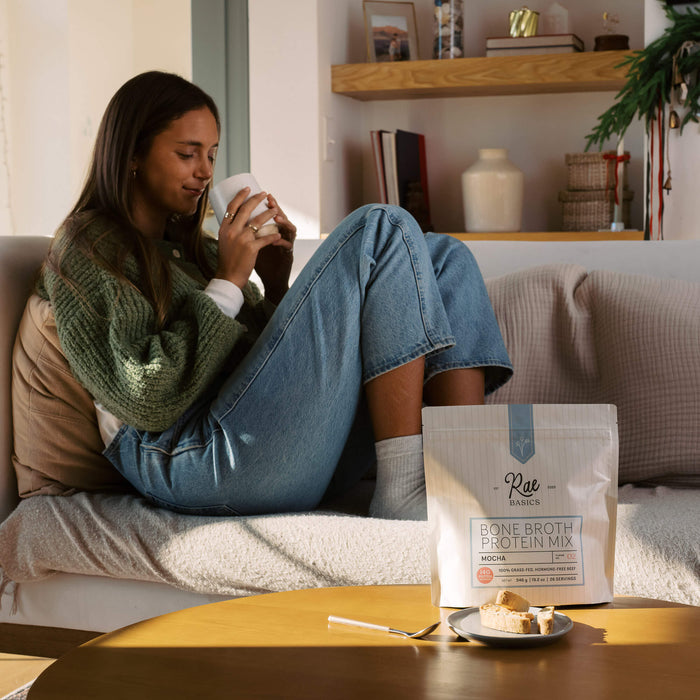
Here's the rest, straight from the Nutrition Facts panel on every bag of grass-fed Bone Broth Protein Mix. One 21g scoop has 14g of protein, 10g+ of naturally occurring collagen, 0g sugar and 80 calories (90 for Chai). Carbs are 3g in Classic Chocolate, Mocha and Caffeinated Chocolate, and 4g in Chai. Every value is on our Rae Basics at a glance page.
Quick answers
What amino acids are in bone broth protein?
Mostly glycine, proline, hydroxyproline, glutamic acid and glutamine, alanine and arginine, with smaller amounts of the essential amino acids and almost no tryptophan.
Does bone broth protein have all nine essential amino acids?
Yes, all nine show up in our lab profile, but tryptophan is very low: 0.10g per 100g of protein, about 14mg per scoop. That's why it isn't a complete protein. Eggs, dairy, meat, fish or soy elsewhere in your day fill that gap.
How much glycine is in a scoop?
About 3g. Our lab profile shows 22.31g of glycine per 100g of the bone broth protein, and each scoop has about 14g of that protein.
Is bone broth protein high in leucine?
No. Collagen-rich protein has about a third of the leucine of a typical mixed diet, so pair it with leucine-rich foods like dairy, eggs or meat if keeping muscle is your goal.
Why is hydroxyproline important?
It's found almost only in collagen and helps give collagen its stable structure. Along with glycine and proline, it's one of the building blocks your body uses to make its own collagen.
Sources
- U.S. Department of Agriculture, FoodData Central. Gelatins, dry powder, unsweetened (FDC ID 169599).
- Paul C, Leser S, Oesser S. Significant amounts of functional collagen peptides can be incorporated in the diet while maintaining indispensable amino acid balance. Nutrients. 2019;11(5):1079.
- Li P, Wu G. Roles of dietary glycine, proline, and hydroxyproline in collagen synthesis and animal growth. Amino Acids. 2018;50(1):29-38.
- Razak MA, Begum PS, Viswanath B, Rajagopal S. Multifarious beneficial effect of nonessential amino acid, glycine: a review. Oxid Med Cell Longev. 2017;2017:1716701.
- Cruzat V, Macedo Rogero M, Noel Keane K, et al. Glutamine: metabolism and immune function, supplementation and clinical translation. Nutrients. 2018;10(11):1564.
- Bannai M, Kawai N. New therapeutic strategy for amino acid medicine: glycine improves the quality of sleep. J Pharmacol Sci. 2012;118(2):145-148.
- Amino acid analysis of our grass-fed beef bone broth protein ingredient, supplier report (on file).